Monday, January 12, 2015

I am so Over all the Optimism and Heart Health Articles

I just know something is wrong with this study, bad wrong.  But when I try and analyze the findings and results, my reaction is one of confusion and anger.
Yes, I am smiling like the person in the study photo!  I am optimistic! (Fooled you :) )

Confusion is a dissection symptom confronting me daily.  My confusion is not normal, but the fact that I stay confused on a daily basis is a normal daily issue I am used to.

But anger is not one of my normal responses.  So when I got really irritated after reading about the study described below I knew something was up.  I just had to figure out what was wrong.  Why was I so mad?

First of all the study seemed to be positive, good news rather than bad.  The title. "Optimism and Cardiovascular Health.  Multi-Ethnic Study of Atherosclerosis" even had a 'feel good catchy' ring to it but cost thirty seven dollars to buy.  I stayed content with reading the many third party reviews of the study.  Thirty seven dollars will be better off spent on my numerous medications.

So in all fairness I am not qualified to review the actual study.

But I can give you my thoughts on the way numerous national publications such as, TIME magazine's review of the study in their recent article entitled, "How Optimism Might Be Good For Your Heart"; and U.S. News and World Report's "Study Suggest Correlation Between Heart Health and Optimism".

The U.S. News and World Report's write up offers a by-line  under the title that says: "Smile.  It'll make your heart happy."  The article lead photo features a smiling young person holding a cup of coffee with the caption, "A new study suggest optimism could be linked to cardiovascular health."

The write up quotes the study's author, Rosalba Hernandez, as stating, "individuals with the highest levels of optimism have twice the odds of being in ideal cardiovascular health compared to their more pessimistic counterparts."

Apparently, abundant optimism is more often than not a companion to lower blood sugar and cholesterol levels, higher levels of physical activities, healthier body mass index measurements and lower rates of smoking.   The article did not really specify if optimism produced the healthier attributes or if optimism was a collateral product of possessing these healthy attributes.

My immediate take away impression though was one of guilt and anger.  I felt guilty because even though I try to stay optimistic, I am also realistically pessimistic too.  I say realistically pessimistic because I struggle with physical and mental issues each day.  I am not always 'happy go lucky' or all 'smiles' like the photo of the young woman in the article.

I asked myself, 'am I doing something wrong?'  Ouch!  It hurt to smile like that.

What about all my friends who struggle with Marfan Syndrome issues or those living, like me, with aortic aneurysms and dissections?

I think of their ongoing surgeries and pain and daily struggles.  The line from the OneRepublic song "Counting Stars', "everything that kills me makes me feel alive" is so true for many, including myself.

"O.K. Kevin, take the article in context," I told myself.  Perhaps the article was written about the average person, you know, the one without Marfan Syndrome or a dissected aorta or cancer or other serious health issues.  Perhaps the article was written about a 'normal' person.

But many studies show Americans are really less healthy and die sooner than others in the world.

The Huffington Post states that only one in three Americans are truly happy.  Yet Huffington also tells us that 92% of Americans are actually optimistic.

So we are optimistic, unhappy and a third of us are truly healthy.

Is the take away from the articles about optimism supposed to be 'if I smile and act perkily bubbly, then I will be healthy?"  I don't think so.

Thankfully, the last line in the U.S. News and World Report actually helped me make sense of the entire issue of optimism, happiness and cardiovascular health.

The last sentence mentioned a study entitled "Heart Health When Life is Satisfying".  This study proposed that heart health is really promoted when the basics of life - one's job or purpose, one's family, one's sex life and one's self all exist in a stable, satisfactory state.

One's love relationship, leisure activities or standard of living actually had little or no measurable positive impact on cardiovascular health.

I can grasp this concept of a 'stable, satisfactory state' affording a positive benefit to cardiovascular health.

Walking miles for daily water can be a satisfactory state when one returns with water to a loved family, weary but fulfilled after the hard work.

I cannot relate to the more optimism - more heart health line of reasoning when the  whole 'optimism' premiss is based around the ostrich concept.

In fact, I would label this more optimism approach as one of denial.  Deny the fact that our diets do not contain outrageous amounts of sugar, salt and inflammatory substances and our bodies will be deceived into rushing forward, fueled by adrenaline, until we collapse.   Deny that our hectic, out of touch with nature lifestyles contribute to hypertension.

We exist in a state of optimistic denial.

Today I am alive.  I am momentarily stable and I am in a satisfactory state with respect to life's fundamentals.  That is good enough for me.  I can't be the young person with the big gleeful smile in the article's main photo. It'd be a contrived smile.  I can grin a little though.

I am just so over people and media telling me that an optimistic attitude and heart health go hand in hand.

So let's be realistic.  I am alive.  I woke up this morning despite all the hurt and heart-aorta worry and bet that if truth be known, my sometimes pessimistic, dire outlook and attitude, combined with my daily walks, spirituality seeking moments, non-processed food diet and medications make me just as heart healthy as most others - even if it is my own perception.  Yes, "everything that kills me makes me feel alive."  It does.  It really does.  I acknowledge that despite the hurt and pain and struggles, despite the dour smirk, I am complete.

In my old age I have decided that there really are no answers, just questions.

After reading all the optimistic health articles and writing this post I am even more confused about everything heart health related.

I think I'll go take a walk and listen to the birds sing in the drizzling rain outside.  They sound happy and look healthy.  Are birds optimistic?

And it always pays to listen to the little birdies.  When I walked out in the drizzle, one whispered in my ear something astounding!

So I went back into the house and did a little research and the bird was right!

The Huffington Post actually reports that university studies show that pessimists live longer!  It is right here in this link! Yes!

I am vindicated.

And I am even more convinced there are no answers in life.  Only questions and my dour smirk or perky grin, depending on how bad I really hurt.


Saturday, January 3, 2015

Seeking and Arrival. Aortic Dissection and Marfan Life Challenges 2015.

2015 is here!  Wow.  I dissected back in 2011, having my last open heart surgery in 2012.  Honestly, the thought of living this long never entered my mind and I remember weeping silently one day at thought of not seeing the two teens up and grown.
Staying warm to keep Raynauds at bay in the hot Florida sun.
But Jincy is off at the university and well on her way to becoming self sufficient.  Ruairi took his first big overnight road trip all by himself last week.  His grades and scores are high enough to get him through college on scholarships and grants.

I still need to finish my what to do when I die notebook, but for the most part all the paperwork is in order.  When this last effort is complete another worry will disappear.

For the most part the 'now I lay me down to sleep' panic attacks are still there.  But now I am able to accept mortality possibility with a 'thank you for another day' and a 'frankly my dear, I don't give a damn', shrug.

No, I am not giving up.  Judy and I have a lots to do together.  I would like to see the kids finish university and enjoy the grandchildren!  But I am wore down from the stress of worrying about living each hour like it is my last.

Time flies by so fast.  Best spend time not worrying so much.

2014 was hard and I was hoping 2015 wold be a fresh start.

And 2015 has already taught me a lot.  But I was hoping for a stress free, better than last year twelve months, season in life.

Yesterday Ruairi said, 'Dad, the butter is soft'.  

We use real butter, I told myself.  Real butter is always soft, right?

'Is the refrigerator OK?', Ruairi asked.

Real butter is always soft, I told myself again.  If I say that enough the refrigerator will be ok.

But something was really wrong with the refrigerator.  I knew it.  The unit had been making funny noises lately, kind of like someone throwing the small cast iron skillet around the kitchen sound.  I thought the problem would go away if I played Carlos Santana long and loud enough.

It Never ends, I thought and shrugged.  I never arrive.  I will never get there.  New roadblocks pop up every day!  Heck and throw in some '#$%&(2@$XXX' for good measure.  It never ends.

Don't they realize… 2014 is over!!!

Lets see.  Last year we repaired or replaced every appliance in the house, except for the garbage disposal and it is next on my list because it too, like me, is dysfunctional.  

In addition to the garbage disposal, the outside air conditioner compressor electronics went out.  We fixed them.  

The inside air handler furnace in the garage caught on fire and burned out the entire unit.  We fixed it.  Thankfully the house did not burn down.

The washing machine died, dead in the water.  We fixed it by ordering and replacing the water pump.  Try disassembling one.  

The clothes dryer stopped drying clothes.  Believe it or not repairing the clothes dryer was more difficult for the family to fix than the washing machine.  

The refrigerator went out in early spring.  We fixed it.

The dishwasher died.  We replaced the dishwasher.

The microwave door fell off.  Turns out it is more expensive to replace the door than buy a new microwave.  We replaced the microwave.

The swimming pool pump caught on fire and burned out.  We replaced the swimming pool pump.

The stove quit working. We found a used stove.  It does not matter to me that it is white while all the other appliances are black or stainless.  The stove works.  Well, all except one eye.

The fiberglass shower stall cracked.  We fixed it.

And that's just the house.  The front end of the car had to be completely rebuilt.  We installed a new windshield as the old one's crack just kept getting bigger.  The stupid under sized spare tire got tossed and new rims and five new tires were purchased along with a ton of new engine parts.

I feel so much better having a full size spare in the trunk, especially since Ruairi is driving so much.  We actually put the small spare on one day and it wouldn't even keep the car frame up off the asphalt.  But I can say unequivocally, Ruairi has learned so much about being tool handy.  Learning about replacing skate board wheel bearings opened many handyman doors for him.

Speaking of automobiles, the State of Florida permanently revoked my drivers license based on my medical condition.  Not a suspension mind you, I am now a permanent 'driver-non-grata'.  

Yes, I have figured out how to bike around town and I walk everywhere and feel better physically for it.  Actually if I don't walk fluid accumulates around my ankles so I must walk every day as far as I can.  

Collaterally, the loss of my drivers license after forty years of being a safe driver, affects my self worth much more than being any inconvenience to getting around.  

Don't get me wrong though.  Pedestrian life is definitely hard.  Even with all the sidewalks around town, this city as well as most others I suspect, are not designed for accommodating pedestrians or bicyclists, especially disabled ones.   

Cities are designed around the automobile.  No wonder we have such a hard time transitioning to sustainable city life.  

One is supposed to be in the prime of their life career during their 50's.  Now if I have someone express interest in my expertise they disappear as soon as my 'no driver's license' issue comes up.

In all reality though I think I may be in more danger of dying from being hit by a car than my imminent aorta rupture.

But the wise medical review board for drivers thinks my existing aorta condition is best kept from behind the steering wheel.   

And 2014 did bring a couple of significant bleed outs.  One was so bad I had Ruairi drive me to the ER in St. Augustine.  I honestly thought my dissected renal artery had popped.  Turns out I lost about a quart of blood from an internal connective tissue tear.  The blood sloshed around my waist for about a month.
Last Bleed Out Episode.

And talk about aneurysms, our second eldest daughter is still recovering from a brain aneurysm that left her almost blind.  We took care of her two teens for half a year which was a true blessing, affording us the opportunity to really spend some quality time with two of our grandchildren.

My cardiologist says, 'we don't want to open a can of worms' when I ask him about what we should do for my large descending aorta and renal artery dissection.  Then there is the carotid dissection that we haven't really started analyzing yet.  Probably because my brain can not even wrap itself around that concept.

I AM so glad I've finally figured out all this is the result of a connective tissue challenge but I still have so many, add another 'so many; for emphasis, unanswered questions.

I just knew 2015 would be the year I could arrive at the answers to my health questions.  

Last year I was able to at least label many of the questions I had about what was wrong with me.

My biggest challenges are (in order of severity): 

1. a paper thin aorta that I can't do anything other than have the entire descending section replaced with a Dacron tube - I don't think I can do this.  The Dacron graft on the ascending portion almost killed me while saving me; 

2. vertigo to the point of having to sit down numerous times on my daily walks.  Interestingly, I think it is a combination of being on the heart-lung machine for so long (pump head symptoms) and a eye-ear-brain short circuit.

Not only does my pulse of 40 beats per minute and low blood pressure make me dizzy, but anything complex sends me reeling. 

For instance, walking on plain white concrete sidewalks is usually OK.  But if I walk across intricately laid pavers I typically spin out and end up on the ground, sitting still with my eyes closed until the vertigo stops (hopefully).  As a passenger in the car at any stop light I have to look away from the whizzing cars in the intersection or the vertigo starts again and BOOM my head is against the door.  

Others have told me how the radio or even the telephone can be a trigger for vertigo.

So I've had to learn to look up when walking across pavers, praying the clouds shapes are not too complex.

Facebook and Twitter are gone from my phone now.  The other day I opened up Facebook and had numerous notifications, somewhere around fifty or so.  My brain instantly painted a picture of fifty small, smiling avatars each calling to me at the same time and BOOM BOOM I was on the floor again. 

Facebook has allowed me to find seriously good, helpful support groups and I've made internet friends around the world.  But I open the app and a cross between the feeling of laughing gas, a walk through the carnival's moving funny house wheel and an out of control ferris wheel kicks in.  I have to find the floor fast and never go anywhere without my cane or crutch.  Surprisingly, I have learned to do some cool baton type twirling with my cane. 

Complexity of any type - visual, audio or motion based brings on instant immobility and a way too intimate relationship with the floor below.

3. immobilizing Raynauds Syndrome - once the temperature drops below 60 F my fingers and toes turn blue, I loose feeling and my pulse jumps into overdrive to try to pump blood into the constricted periphery vessels - there is not much I can do about this other than stay warm or get a job as an icicle (if no drivers license is required);

4. memory loss is so difficult for someone who loves words.  At first the fear of Alzheimer's plagued me constantly.  But now I recognize the inability to recall short term memory as one of the results of surviving those nights in the ER with a disconnected heart.  The neurologist says 'cognitively challenged' as a result of embolistic events.   I hear you Vincent.

5. depression. ugh.  Depression really is a bad thing.  Walking helps.

Thankfully there are those close to me who have gone through similar operations and cannot find the words for their thoughts sometimes and the vertigo and the other issues also.  I am not alone with this challenge.

But I just KNEW 2015 was going to be better.  2015 was going to be the year I arrived.  2015 was the year of the destination.

Then on January 2nd the refrigerator broke.  This was a sign of what was to come!  I was floored (not literally this time but I did have to sit down).

I've got to get to a point in my life where I can focus on what my primary care physician says - 'your number one job is to stay alive, Kevin'.  I need to focus on health, not on machines.

People look at me and see a tall, fit man.  I've managed to control the beta-blocking result of weight gain because I walk so much.  I look healthy.  Because I look healthy people think I am healthy.

If I try to explain what I face daily most scratch their heads and think one word - 'hypochondriac'.

Or the evangelicals sometimes say - 'I am glad I did not buy into believing what my doctors told me'.  I am tempted to ask 'then why are you dealing with those horrible hemorrhoids?'  But instead I just smile and shrug.

So the world expects me to keep going at breakneck speed, machines and people both.

And to start the new year off right, the refrigerator broke.  Not an auspicious start to an arrival year.

Today I placed a chair in front of the stainless doors and sat down, staring alternatively at the closed door, the bright fluorescent light inside and then the outside of the closed door once more.

I know nothing about refrigerators.  I waited for the machine to speak to me and tell me what was wrong.  My cocktail of heart and other such medications sometimes provides unique visions and I hoped for spontaneous enlightenment about freon and condensation and such.  Where are you John Gorrie?

I can't buy a new refrigerator and would not even if I could.

Sitting in the chair I could vaguely see my reflection in the smudgy but pretty clean stainless door.  I felt sorry for the man I watched in the door's reflection.  Pity party time.  But the more I stared the louder  my artificial heart parts clanged (is there such a word?).

Sheez.  I'll never get to where I need to be. I muttered.  Stupid refrigerator.  I need to be exercising my rotator cuff, not probing around inside a dead refrigerator's innards.

Then, as I opened the door once more the fluorescent light inside almost knocked me over - this brilliant, bright light - road to Damascus bright, light popped on and shown deep into my head.  Thankfully it did not blind me.  More thankfully it was not so complex so as to cause me to fall over out of the chair onto the floor.

It was one of those really plain, simple pure white concrete sidewalk moments.

I had already arrived.

All that broken appliance stuff from last year really was meaningless in the big picture.  Happiness, wealth and fortune is not really found in possessing fine appliances and a driver's license.

I may be poor but I am really rich.  I am a rich pauper.  I am truly blessed.

As I sat there staring at that piece of stainless junk….. wait, let me re-phrase….

I had just been gifted over 36,000 heart beats and it still just a little after noon.  Add to the 36 grand heart beats another 5,000 or so breaths.

As Jesus says, 'Peace, be still'.

Thats all that matters.  I am alive.  I have family who are healthy and happy even though they too are struggling with their challenges.

The steel will rust and plastic melt.  If I wait until the machines and people are perfect then I am 'SOL'.

I really have got there.  I found the end of the rainbow in 2015.  

So for the rest of the day I said 'thank you' after each breath.  I tried saying 'thank you' after each heart beat but found myself on the floor again.  Keep it simple.  The destination was never really that far away. In fact the destination I was searching for was always near by.  Dorothy's face floated by.

Yes, my depression won't go away and neither will my dissected aorta or my Raynauds or that horrible vertigo or my friend's hemorrhoids; and the appliances and car will keep breaking.  

But all that I asked for - the space to work on my challenges - is already here.  I just had to accept it.

I have arrived.  I am rich beyond imagination too.

What an awesome 2015!


Wednesday, November 19, 2014

Cold Weather, Aortic Dissection, Strokes and Ischemic Events

Cold weather is hard on my heart.  In addition to Raynaud's Syndrome I just do not like being cold.  Growing up in South Florida I have always craved warmth and bright sunlight.

This week the arctic blast came through.  My periphery circulation constricts and my heart goes wild trying to pump enough blood to my ice cold finger and toes.  My pulse has doubled over the last week from an average of 45 bpm to well over 100 now.  I have doubled up on my Losartan dosage with my cardiologist's permission.  The increase in Losartan helped last winter.

Some web resources indicate more strokes and ischemic events occur during the cold weather.  Unfortunately, even aortic dissections seem to be more prevalent during cold weather.

Right now I have a hot cup of green tea in my hand while I 'peck' the computer keyboard with my left hand.  Gloves work too.

Stay warm this winter season!

Monday, October 27, 2014

Chronic Vertigo and Dizziness After Open Heart Surgery

Next month it will be the three year anniversary of my ascending and descending aortic dissection.  I still struggle with chronic dizziness, light headedness and vertigo.  The feeling that I may pass out at any time really hasn't gotten much better and I refer these symptoms as my 'Swirling Head Syndrome'.
Vertigo, Dizziness and 'Blacking Out' are, I think, a result of 'Pump Head' and Blood Flow Issues
Unfortunately, I feel like I am going to faint at almost any given point during the day.  The wooziness though is especially pronounced when I move, stand up, bend over, walk, ride my bike or try to drive.

I do not drive any more for a number of reasons.  First and foremost I recognize I am a danger to those in the car with me and others on the road.

If you have had open heart surgery requiring significant time on a heart-lung machine then you too may be experiencing chronic dizziness, loss of memory, vertigo and other balance-awareness issues.

Some call this phenomena 'Pump Head' after the heart-lung pumping process.  My neurologist refers these symptoms as a result of 'embolistic events' occurring during and post-open heart surgery.

But I have pin-pointed four main symptom-sources of my Swirling Head Syndrome.  They include:

1. My eyes, especially my right eye, will loose focus and everything turns dark grey at random times.  These episodes last for five to ten minutes or so and when they happen I have to sit or lay on the ground to keep from falling over.  As soon as this begins I stop my bicycle, lay it down on the ground and sit until the vision returns.

It takes about three to five seconds for the eyesight to be completely gone and the blurry part lasts about two to three minutes usually.  My eye doctor does not know what causes this but she has told me I do have a small aneurysm in my right eye.

2. Secondly there is that tingly feeling in the top of my head I can best describe as like what I feel when breathing the knock-out gas before a colonoscopy; the kind of fuzzy feeling where my ears start ringing and my awareness seems to dissolve into a state of unconsciousness.  This I usually feel throughout the day and is usually associated with standing up, moving, walking, turning or any activity involving motion.

3. Third reason I become faint is when my right kidney starts hurting really bad or the false lumen in the descending dissection begins to tug and pull.  This is not an incision pain.  Rather this pain is an intense, strong hurt.  I experience this pain most days and have learned to 'breath' through the waves of intensity until they pass.

Sometimes my brain thankfully shuts down and I black out momentarily.  I have never had any of my doctors, not one, ever discuss pain management with me beyond the narcotics I was given for a brief period of time after the open heart surgery incisions.

4. Finally I have a difficult time processing complications.  When I say 'complications' I mean anything non-simple.  If I am walking and come up on a section of walkway with different color paver tiles laid in different patterns then I will quickly become dizzy and have to sit down and look up for the sensation to subside.

Before my drivers license was suspended I would encounter the same situation at intersections.  Soon I became terrified I was going to hurt someone with my inability to process how to navigate the automobile in and around other vehicles.

Well stocked grocery store shelves with hundreds of colorful, different shaped containers send me reeling.

But I am focusing on trying to improve my Swirling Head Syndrome issues through memory and concentration exercises, diet and physical therapy, and writing my blog.  But the blog writing is so frustrating.  Where before I had excellent word recall now I must use a thesaurus or dictionary with the composition of each paragraph.

Maybe, over time, the pump head and other aortic dissection related effects will begin to subside and resolve themselves.

I would really like to be able to drive again someday - that is if I can do so safely.

Apparently 'pump head' or 'Swirling Head Syndrome' is a fairly common challenge aortic dissectees deal with.  After three years it is still swirling through my head.  If you are struggling with the same, don't feel alone.

Saturday, October 25, 2014

Designed to Help Disabled? 'Normal' Persons May Not Understand Disabled Life.

As a disability challenged person living in a world designed for 'normal' people, everyday brings on tough new gauntlets to navigate.
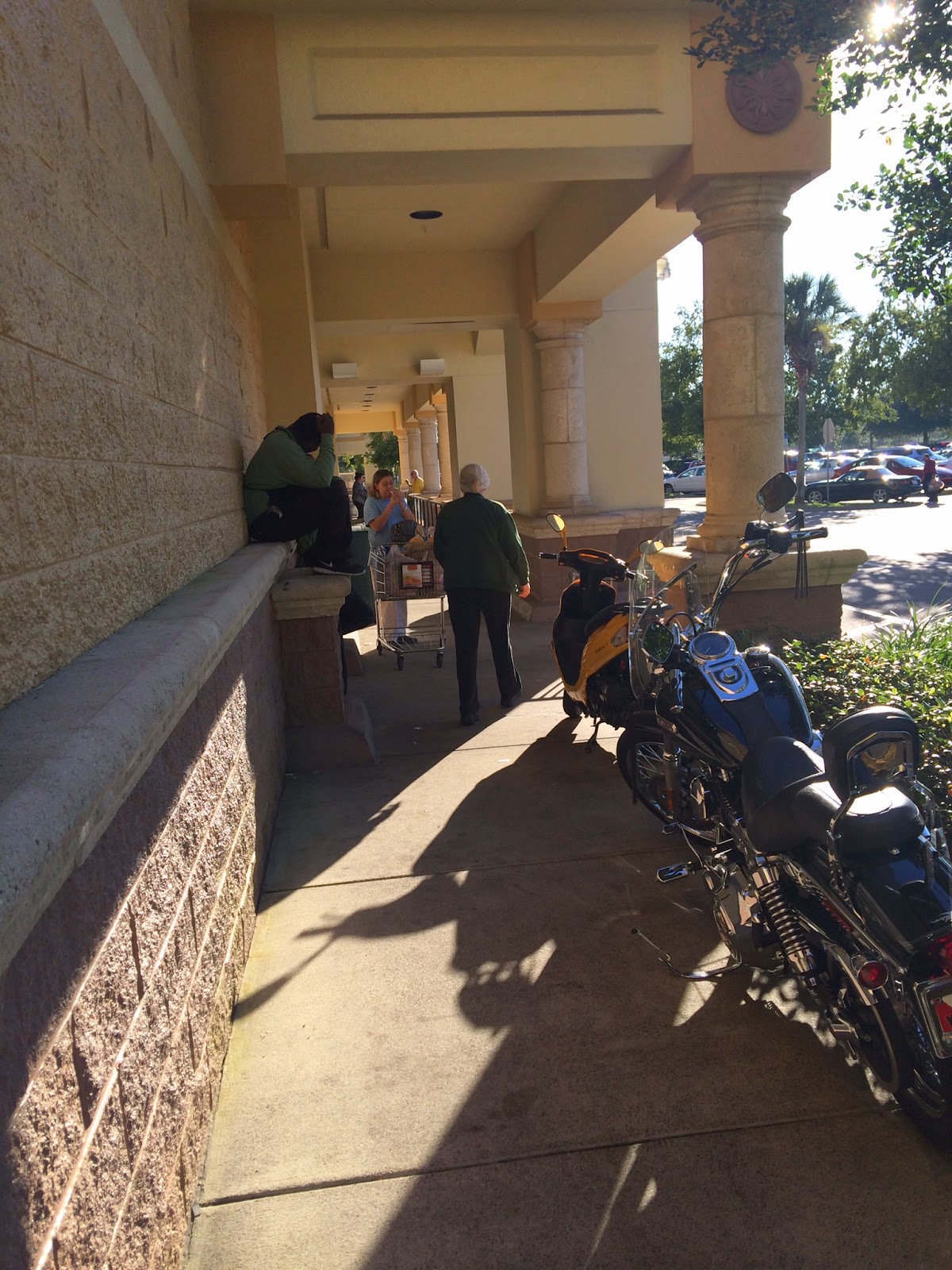
Publix bicycle rack is also the location for employee smoke breaks.
As a disabled cyclist I am forced to walk through second hand cigarette smoke to use the Publix Bike Rack
Unfortunately as the world moves ahead with new buildings, roads, cities and infrastructure, those of us who face life physical and mental challenges are still being left far behind.

Yes, there are many advocate groups who do good and help keep the issue of being 'different' than most out in the spotlight, and I am thankful for these efforts.  Groups such as the National Organization on Disability, American Association of People with Disabilities, The Arc, the National Disability Rights Network, and others all have a web presence.  Some offer links to helpful references and other provide useful information such as contact telephone numbers and addresses.

Yet even though advocacy groups may influence broad reaching policy decisions and have a positive effect on me as a 'disabled' person, I still encounter needless and thoughtless situations where I am discriminated against daily, especially with respect to access and transportation.

Yes, today there are many marked improvements in our surroundings and cities that have a profound effect for good for those of us living the disabled life.

Granted, most of us disabled persons can now use sidewalks with non-skid ramps instead of a steep curb, and rely on cross-lights that talk, whistle or beep to alert us of changes in traffic flows.  Too, there are automatic doors and widened bathroom stalls with reachable sinks.  Even most public transportation systems are 'disabled' friendly now, in many ways.  This is all well and good but there is still so much room for simple, straightforward and uncomplicated improvement.

Sometimes the most simplest, obvious things that can help a physically or mentally challenged person are those things 'normal' people tend to overlook and are the easiest for the world in general to forget.

For instance, I bike my world.  I have to bike my world because my drivers license is medically suspended due to my dissected aorta and side effects of the medications I take to keep my heart just barely beating in 'anti-rupture' mode. I am 'OK' with living my life as a cyclist though it presents difficulty at times.

Our local grocery store, Publix on Palm Coast Parkway has graciously installed a bicycle rack to the left of and not too far away from the front door.  I am grateful for the bike rack.  Many stores or facilities, even those you would think would have bike racks, do not provide bike racks.  But they all provide a massive amount of parking spaces in huge asphalt or concrete paved parking lots for the car drivers.

Back to the bike rack.  I am grateful to Publix for the bike rack availability.  I love their grocery store and they are one of the few places where I can purchase high quality, reasonably priced organic foods.  I depend on healthy foods to support my kidneys (which are recovering from total failure after open heart surgery) and my dissected cardiovascular system.  Unfortunately Publix employees keep forgetting that as a cyclist who uses the bike rack I must breath in all the second hand cigarette smoke their employees cough out when they take their smoke breaks immediately adjacent the awesome galvanized bike station.

This is just a typical example of 'normal' people not having a clue what the physically or mentally challenged persons have to go through to adapt to the 'normal' world.

I have sought out the store managers and asked repeatedly to have the employee smoke station moved away from the bicycle rack area.  The tall young female manager usually makes this happen for a day or so but then the entire must breath second hand smoke begins all over again.  I ask again and the smoking stops for a day or so yet begins once more soon afterwards.

Compounding the problem, customers who exit the store see the employees smoking and light up right next to the bike rack also.  
As a disabled cyclist I am forced to walk through second hand cigarette smoke to use the Publix Bike Rack
'Normal' people - those driving cars - don't have to walk through the smoke, rather they walk in through the front doors through areas away from the smoker break section.  If the employee smoke break section was adjacent the front door and 'normal' customers had to walk through the smoke, the smoking would immediately cause an uproar from 'normal' persons.

There is a very easy solution to this problem.  Publix should install a 'No Smoking' sign around all store entryways AND the bike rack area.  It should be obvious that if I purchase organic foods, those fruits and vegetables and meats free from pesticide, herbicide, antibiotic  and hormone contamination, then I also want to breath clean air.  I especially do not want to re-breath air hacked out by a smoker.

Second hand cigarette smoke just really does not fit the image of a Publix grocery store either.  So I don't get it.  But I am not a 'normal' person.  I am a person living with 'disability' issues.  I suppose the only way to get things changed is to raise awareness.  If asking does not work, continue to raise awareness by blogging about it.

A 'No Parking' sign may be too obvious also.   So after the second hand smoke from Publix employees, I had to deal with a construction truck driver who decided to park on the way home sidewalk and probably had no idea how important a clear sidewalk was to a person in a wheelchair or on a bike.

It is hard enough to navigate the construction areas around Palm Coast Parkway.  No pedestrian access is provided through or around construction areas during the ongoing widening project of the roadway.  Yes, access was provided for automobiles but none for pedestrians or for those in wheelchairs or on bicycles.  I do not think this was an intentional oversight.  Rather I think 'normal' people just don't have any concept of what it is like to life of a physically or mentally challenged person.
Automobile drivers have little concept of what life without a car is like.  For those with a disability a sidewalk can make life doable.  When the sidewalk is blocked this presents a potential to fall or otherwise injure one's self.
So to most parking a truck on a side walk is no big deal.  But to me, carrying bags of groceries on my bike it is a big deal.  I have to slow, stop, dismount my bike (hard enough under normal conditions) and walk around the truck, hoping my Marfan weakened ankle doesn't give out or my bike turn sideways off the sidewalk edge, spilling the groceries across the grass.  To me it could actually cause physical injury.
One would think a large construction company would recognize the need for disability and pedestrian access around construction projects.
A 'No Parking' sign along the sidewalk would be way too obvious.

Sure, people without disabilities have to deal with these second hand smoke and blocked sidewalk-no pedestrian access issues too.  But they are not forced to do so.  They have the option of their automobile.  If I want to carry any amount of groceries home I need my bike.   The Publix bike rack is right in the middle of the employee smoke break section.  

So I will continue to write about these challenges and maybe someone out there with a child, brother or sister or friend who struggles with life's physical and mental challenges, someone who is also 'in charge' at a grocery store or construction company or other corporation of governmental entity might read this and say 'I can help make a change'.

It doesn't hurt to ask.  It does hurt to continue to have to breath second hand cigarette smoke or twist an ankle or break a leg trying to navigate an automobile-less world.

Speak up if you have a life challenge.  Awareness is the only way we can make the world a easier place for those of us today with disabilities and for subsequent generations.


Monday, October 20, 2014

My Mechanical Aortic Valve has Opened and Closed Over 100,000,000 Times!

Check out the quick video of my St. Jude Medical aortic valve!  Next month I will have had the device for three years (time has flown by).  At 60 beats per minute average the artificial aortic valve has opened and closed 100,000,000 times.  That is totally amazing.  I sure hope it keeps going!

Sunday, October 12, 2014

Heart Healthy Drinks - Lemongrass and Hibiscus Tea for Non-Processed Food Challenge Drinks

October has been the non-processed food diet month.  For twelve days now I have been only eating all organic fresh fruits, organic fresh vegetables organic-grass fed dairy, meats and fish.

Freshly harvested lemongrass in the dehydrator, heart healthy  herbs
Water has been my main liquid and I've been drinking lots of it, about three or four liters a day.

So today I decided to make some tea from the garden.  We have lots of lemongrass and Jamaican hibiscus (Roselle)  in the front yard (and in the side yards and in the back yard).
Lemongrass row planting in our front yard, heart healthy herbs
Lemongrass tea besides tasting wonderful provides a variety of health benefits.

Other favorite tea plants of mine include the Jamaican hibiscus, or Roselle and another garden perennial cranberry hibiscus, both offering healthy properties, including lots and lots of important Vitamin C.   Roselle calyces are used to make 'Red Zinger' tea and other island drinks, and since the tea has mildly diuretic properties it is good for blood pressure, kidneys and the heart in many instances.
Cranberry hibiscus, Hibiscus acetosella (L) and Roselle-Jamacian Hibiscus, H. sabdariffa (R) in our front yard

I usually clip a handful of lemongrass stalks, while picking about a cup of the hibiscus leaves and calyces and a handful of leaves.  After rinsing I place in a stainless pan with filtered water, bring to a boil and let simmer for an hour
Jamaican hibiscus & lemongrass tea for heart health - non-processed food challenge
After straining the tea I pour into a glass container and chill in the refrigerator.

For delicious variations try adding fresh ginger, key lime or lemon juice or cinnamon to your lemongrass-Jamacian hibiscus tea, and as always, check with your doctor before using any new herb or medicine.

Cheers!

Footnote:  Most fresh teas are much better for you than sweetened soda or colas, however always check with your doctor first, especially if you are taking medications or are pregnant.  In this case lemongrass (the phytochemical citral) contains compounds that encourage estrogen production while some studies have shown that roselle actually lowers estrogen levels.