Thursday, December 27, 2018

#Aortic Dissection Diet - Healing My Aorta Wall, Quinoa Tuna Burgers

Kevin's Quinoa-Tuna Burgers.
Aortic Dissection focused diet has provided me an opportunity to explore new food combinations.  These quinoa-tuna patties are full of nutrients & protein. (Mustard makes an excellent condiment).

Just like anyone else, an aortic dissection survivor needs protein to stay healthy.

Most of our meals are whole food, slow cooked veggie based dishes.   Albeit a much slower but still active dissection life day can sometimes leave me with a hearty appetite.

So I've been making these Quinoa-Tuna burgers for some time now.  They are fast, easy made from just a few ingredients, healthy and delicious.
Aorta healthy quinoa tuna burgers are easy to make, grill & delicious to eat.  They are good hot or cold!

For starters quinoa is generally considered to be a seed and not a grain and reportedly contains most if not all essential amino acids our bodies require.

Quinoa is a solid protein food and muscle builder.  Fiber is another important digestive benefit we receive from quinoa.
Quinoa is available in white or darker colors.  Here I am using organic red quinoa for my #Aorta healthy quinoa-tuna burgers.

And I love seafood.  Although small fish such as herring are my usual fare, tuna is a once every two week treat.  Fresh tuna is always best but if not available then a quality canned or jar supply of the fish will work.

Pasture raised organic eggs add to the nutrients and protein scorecard.

Between the tuna, quinoa and eggs one average sized Quinoa-Tuna Burger will provide approximately 15 grams of protein.  I can easily eat two, sometimes three.  So there is most of my protein requirement for the day.

Here is how I make these mild seafood patties:

1. Chop/dice one medium size onion & add to mixing bowl.
2. Fine grind one cup of quinoa in coffee grinder and add to mixing bowl.
Quinoa is one of my go to #Aorta healthy foods

3. Open two cans of tuna, drain & add to mixing bowl.
4. Add three organic eggs to the other ingredients and mix until well blended.
We always try & use pasture raised hen eggs to receive the maximum #aortic nutrient benefits from eggs.

5. Place parchment paper on baking sheet.
I drizzle a little organic EVOO over the #Aorta healthy patties

6. Shape burger mix into pattie size burgers (slider size works too) and place on parchment paper.
7. Cook on BBQ grill, med-high (425F) until crispy on both sides.
Delicious Aorta healthy diet variety is easy to mix & grill with these quinoa-tuna burgers.


You can serve these Quinoa-Tuna burgers fresh up or sandwiched in between two slices of a  healthy bread with fresh veggies.

Great way for me to get my fill of 'solid-hearty' food when normally eating my simple vegetable-based diet.

I've definitely seen health benefits from my whole-real, home-cooked diet.  My last HDL/LDL blood work ratio scored in the 'extremely healthy' range.

Enjoy!  Kevin

Thursday, December 20, 2018

Aorta Dissection, Marfan Syndrome & Chronic Health Management Through Art Therapy

One of the easiest ways to keep my mind off my existing #aortic dissection and other #Marfan related conditions is through regular participation in art therapy.
Aortic Dissection Health can benefit from Art Therapy.  This piece by Kevin is a mandala featuring thyme and mermaids.

Art therapy can involve any number of creativity modalities, including; music, painting, sculpture, writing, poetry, culinary creativity, wood carving, metal working, dance, yoga, wilderness hiking, and much more. 

One of my favorite forms of art therapy poetry is short verse such as haiku, senryu and hiaga.

Painting is also a personal enjoyment and I especially like to use pigment with wood and a torch.

Aortic dissection healing, especially related PTSD and anxiety issues, can be helped through art therapy.
Digital vector art too is another great form of art therapy for me.  And I'd never pass up a chance to cover surfaces in graffiti!

Aortic dissection health benefits from open air art, like 'legal' graffiti!
Each individual will always have their own preferences and styles of expressing themselves through art.

Aortic dissection art therapy is all about becoming 'lost' in the art process & forgetting stress or pain for a time.
Art therapy has been a very effective management tool for my PTSD and ongoing anxiety and pain post dissection.

I even write quite dark and morbid short verse.  How ever most of my 'ku' is upbeat and nature-centric or senryu, such as:

"sixty beat pulse
St. jude tick tock silent not
mutt stares at my chest".

There are some really good art therapy resources on the internet, including the American Art Therapy Association.

I have to admit that when I started out I couldn't draw a straight line.

But my motto is keep trying!

Pull out your crayons and colored pencils, or brushes and paint and give it a try.  Sure does help me take my mind off Marfan Syndrome and an extremely dissected aorta.


Saturday, December 15, 2018

Managing #Aortic #Dissection, Making A Switch From Coffee to Marshmallow Root Tea in Mornings

Coffee has bee shown through studies to be good for one's health in a number of ways.
Aortic Dissection.  Replacing coffee with marshmallow tea for Barrett's Syndrome caused by my medications.

But I quit coffee.

I'm now drinking marshmallow tea in the morning and I love the taste.

Marshmallow tea is easy to make.  Pour simmering water over the root in a quart mason jar and let seep overnight.  Heat up the tea the next morning in your rice steamer.

Marshmallow root has a long history of healing inflamed tissue.

After reading yesterday's post about my Barrett's esophagus (hey I learned how to spell esophagus) I know marshmallow tea is a healthier choice over coffee for me, personally.

So far so good.  Marshmallow tea has a rich bold flavor like java with an 'awakening' aroma.

I'll update as I see how marshmallow tea interacts with a complicated body chemistry of #aorta medications.

#Dissection life is ever changing!

Friday, December 14, 2018

Aortic Dissection Meds, Trouble From Ingesting Them Incorrectly

Seven years of daily aspirin, warfarin, amlodipine, ACE inhibitors and other medications to help manage my aortic dissection have unfortunately given rise to another health challenge.
#Aortic #Dissection meds may have contributed to development of Barretts Esophagus

My new health challenge probably would have been completely unavoidable if I had incorporated a few simple habits into my medication routine.

My endoscopy last week indicated I have severe esophageal erosion, more commonly referred to as Barrett's Esophagus.  Barrett's may lead to esophageal cancer.

Not all cases of Barrett's Esophagus will lead to cancer, however esophageal cancer is one of the most deadly forms of cancer known.

Typically Barrett's Esophagus is caused by acid reflux.  Risk factors may include obesity, smoking, drinking and acid reflux due to hiatal hernia.  I do have a small hiatal hernia but have never experienced acid reflux.

I don't smoke or drink and my BMI is on the low side of normal at 20-21.

Connective tissue disorder issues (#Marfan Syndrome) may have contributed to the small amount of hiatal hernia yet my doctor seemed to think my Barrett's may have been caused by years of aspirin use, and more importantly, the way I took the aspirin and other meds.

Interestingly my small intestines and stomach showed no dysplasia or significant issues.

But my esophagus was inflamed, severely inflamed.  The biopsies showed major changes to the esophageal cells but no cancer yet.

I am now scheduled to have an endoscopy every two years to make sure that if Barrett's does progress into cancer, it will be caught early and hopefully in a treatable stage.

The photo in the top right of the picture above is taken under a special light on the endoscope to highlight the area of Barrett's.

Perhaps the changes to my esophagus could have been prevented if I had followed the procedures here for proper taking of medications.

As I do now but did not do for the first seven years post dissection, I take a couple of sips of water first, before placing medications in my mouth.  Those few sips help lubricate your esophageal lining and facilitate the capsules or tablets movement on their way down to the stomach.

Once I take my meds I immediately drink a full 8 oz. glass of water.

Before my recent Barrett's diagnosis however I'd pop my meds in mouth and take a sip of coffee to swallow them down.  From time to time I'd even notice that they may not have all gone completely down and I'd take another sip.

Importantly the stomach and small intestines can handle most medications.  Our esophagus though is much less resilient.

Interestingly, once the esophageal lining cells have been damaged, intestinal type goblet cells colonize the esophagus.  These changes can be a precursor to adverse health conditions.

Swallowing aspirin over seven years each morning with a sip of java, has eaten away at my throat.  In fact, some days I'd even chew metoprolol and swallow without water hoping to slow down a really fast pulse even quicker.

Barrett's is not always attributed to oral medication administration yet it can really help reduce risk simply by taking a few sips first then a glass of water after swallowing one's meds.

Aspirin may not affect everyone the same way I believe it has me.  But as of now I am off aspirin and taking my medications with plenty of water.  As always discuss any changes to your life with your doctor before attempting them.

Live and learn.  #Dissection Life teaches me something new each day.

Monday, December 3, 2018

#Aortic Disability Issues Shouldn't be So Difficult to Understand for Non-Disabled

#Aorta Two objects on a table, one is my Telmisartan the other a screw driver bit for my drill.
Come on.  I mean the hardware store manufacturers understand ins and outs of how tools work.  Maybe that's because they were once tool people themselves.

I would suppose most pharmaceutical company employees are not disabled.  Probably some are health challenged themselves or may be disabled.  Yet my perception is that most of them are just rich.

O.K. That last sarcastic comment was underserved.  I am grateful for all my medicines without which I would be roaming the rainforests looking for the right medicinal sprout, leaf, flower or bark.

Disability and aortic dissection life is difficult enough without thoughtless non-disabled persons medical packaging designers making life more stressful.

The two items on my coffee table above are A. a single Telmisartan pill for my blood pressure I take every morning and B. a screw driver bit for my electric drill (actually its a battery powered drill).

So what's the big difference besides the obvious variant uses???

I need reading glasses to see small objects up close.  I also need them to read.

And I keep all my many various size screwdriver bits in a box, all jumbled up.  Yet if I have to use one particular type or size I don't need to stop and put on my glasses and jumble fumble trying to find the right size in the full box because some very intelligent tool person gave thought beforehand realizing an inexpensive color coding stripe might really make life easier for someone looking for a particular size/shape screw driver bit.

I call that genius.  Thoughtful genius.  Probably because the person who came up with the color indicator idea had 'been there done that' looking through a box of almost identical looking screwdriver bits for the right size, wasting a lot of time and probably building up anxiety in the process.

But nope for the Telmisartan.  Four corners and one of the corners has a tab that is confusing at best for a short clipped fingernail to find and pull back.

#Aorta Dissection Life, Telmisartan is difficult at best to open.
The back of the pill container does say 1. Tear . Peel.

But where do I tear & why is it so difficult to peel?  Reminds me of a roll of masking tape that is five years old.  You know, that roll where tape comes off in tiny pieces and is impossible to slide a fingernail under any of the layers.

I'm not complaining.  Telmisartan is a great drug IMHO, better so than Losartan for me because of lipophyllic properties and longer lasting effects.  Does a better job at keeping my aorta from dilating more.

In fact last CT showed a decrease in aortic diameter though I am suspecting the decrease is a variance in the way different radiologists read the CTs.

So cheers for Telmisartan.

Now why can't the pharmaceutical companies take a clue from the tool manufactures and color the corner of the pill envelope where the tear here part is with a noticeable symbol or color?

I don't usually lose my reading glasses but it is a hassle to put them on just to open a telmisartan package.

Even more hassling is the, nope - its not this corner, nope - its not this corner, nope - its not this corner, nope - its not this corner, wait - is it this corner?  Did I miss the tear here?

A really good answer would for the medical industry to hire more health challenged persons or at least seek input from disabled end users as to 'improvements in efficiency'.

I am sure there are persons out there who have become so frustrated with trying to open these little packets of meds that their stress levels soar as do their bloood pressure.  Maybe they even invent curse words I've never imagined.  Possibly hammers have been taken to these obnoxious little packages.  Its a shame that attempting to use a blood pressure medication actually raises blood pressure.

But this is typical disability life, not only for aortic dissection survivors but for all of those who have to struggle to open a package of meds.

Yes I'm sure the medical industry can retort with the packaging safety issue answer.  But that's not excuse, or if they think it is it is a really lame response.

Just add a little red arrow to the package pointing to the corner to tear.

Doing so might make the blood pressure medication a whole lot more effective.

Want to be the best pharmaceutical company around?  Make sure you hire or seek input from the medically challenged.

And while you are at it, please add a colored arrow or symbol on the corner I am supposed to 'tear'.


Saturday, December 1, 2018

Aortic Dissection, Bridging Lovenox From Warfarin For Outpatient Procedures

High tech hypodermic syringes full of low molecular weight heparin fill the refrig door.

Low molecular weight heparin is commonly know as Lovenox.  My cardiologist bridges me off warfarin using Lovenox for a couple days prior to surgical or  other procedures.

Typically I stop taking warfarin two days before an endoscopy or colonoscopy and give myself Lovenox injections.

Lovenox does not usually or significantly affect PTT or INR.  Yet Lovenox is also considered an antithrombotic substance and reduces blood clot formation.

Since my St. Jude mechanical valve can provide a platform for clot formation I require Lovenox when abstaining from warfarin.

Aorta Dissection, Lovenox (Low Molecular Weight Heparin)
My GI doctor likes my INR to be below 2 when conducting an endoscopy, which I will be having done this upcoming Monday. So I need wean myself off warfarin to drop my INR.

All the medications I've been taking may have been having a negative impact on the mucosa lining in my digestive tract.  I suspect aspirin is the primary culprit, along with too much coffee.

So I picked up the preloaded Lovenox syringes from the pharmacy.  Honestly the syringes appeared to look like something out of a fiction flick.

The syringes had an automatic cap enclosure that would spring up to cover the needle once I injected myself with Lovenox.  Obviously the purpose of the auto closure cap was to keep someone else from being pricked by a needle in the trash.

Aorta Dissection, Lovenox (Low Molecular Weight Heparin)
Being a pumphead recipient though, complicated instruments with multiple twists, turns, pulls and pushes, springs and levers can be despairingly confusing.

Well, I asked the pharmacist.  How does one use these syringes?  Do I need to take the cap of the needle?

Hmmmm, he replied.  Let me see.  The pharmacist looked at the syringes.  I've never seen these automatic cap closure types before.  No, I think the cap stays where it is.  You should be able to push the cap against your stomach and the needle goes through the cap and injects you with the Lovenox, then springs back inside.

Oh. Ok, I said.  Thank you.  I'll give it a try at home.

At the house I opened the package and removed the syringe, wiped the injection area with rubbing alcohol and gently pressed the cap against my right stomach area.

Nothing happened.

Maybe I have to push the plunger harder, I surmised and tried again.

No needle, nothing, nada.

Sheeeeez.  I examined the hypodermic closely with my reading glasses on to see if I was missing something.  There were no directions on the package.

Ok.  One more time really hard and I jabbed.

Nothing.  Fortunately I'd not destroyed the syringe or had the Lovenox squirt out the sides of the plunger.

Fortunately too there is you tube.

So I found a link on how to use a self closing hypo and the cap does need to be removed first.

Ahhhh as a bona fide pumpheader I possess valuable how-to tools with my youtube magnifying glass option.

Injection done and complete.  Another tomorrow then endoscopy Monday.  Then a couple more days of Lovenox and warfarin until I'm back above 2.5.

I am so proud of being able to navigate this high tech world of medicine even better than my pharmacist in this instance.

Lol.  Dissection Life.

Tuesday, November 27, 2018

Aortic Dissection Life Lessons Learned Seven Years Post Op

Δακρυόεν γελάσασα
Its been seven years today since severe back and jaw pain prompted me to drive to Memorial Hospital in Jacksonville.

Unfortunately I didn't think to call 911 and parked in the parking garage on the opposite end of the hospital campus from the ER.

Walking from the car I just really wanted to sit down in the cold night and close my eyes. But I kept walking until the glazing lights of the Emergency Room sign shown close by.  Sliding glass doors opened, I walked up to the desk and thankfully the ER doctor on call quickly ordered a CT scan.

And the the rest that followed is detailed on other pages in my blog here.

But what has living for seven years with a Dacron ascending aorta, a St. Jude mechanical valve and an existing extensive dissected descending aorta taught me?

Medical technology is amazing and with every day new procedures are perfected.  No longer is an ascending dissection always lethal.  The first year I was sure I was going to die any day.

I still think I could die any day but so could any of us.  Even my cardiothoracic surgeon often says, "if I didn't see you sitting here talking to me I'd think from your CT scans you would either be dead or on an operating table".  Yet I still wake each morning.  I call it successful adaptation and LUCK.

Seven years has dulled the anxiety of living on a thin line between life and death.  Living with a connective tissue disorder (Marfan Syndrome - for more info visit The Marfan Foundation website) I know genetic challenges are always present.  Today I am really surprised but happy and grateful when I awaken each morning.

Seven years has impressed on me the importance of awareness.  Every ER medical staff should think CT scan first sign of chest or jaw pain.

Seven years I've read and repeated the 'Ritter Rules' every day.

Seven years is time enough to reflect on love of family and show me how much I appreciate my wife, parents, children, grandchildren, siblings and nieces and nephews.

Seven years has given me an opportunity to make and reestablish amazing friendships.

Seven years opened my eyes to how much people really care and will do to help.

Seven years has allowed me to meet many other aortic disease survivors, many of whom I am close friends with, one whom I've emailed back and forth every day for six years, others of whom have untimely passed away.

Seven years has expanded my neuroplasticity to where my mind is now open to on-going learning.  Even though my cognitive function has been compromised due to small strokes from my time on the heart-lung bypass pump, other brain areas have opened up offering opportunities to see life as I never could have before.

Seven years have replaced once fluent speech with ability to express ideas through fun and (I think) amazingly beautiful art rather than spoken broken words.

Seven years has allowed me to take an extra step each day, strengthening my body from not being able to sit up to now move about (though my cane or crutch is always at hand).

Seven years has been time enough for me to learn appreciation of nature and just how beautifully amazing our universes and cosmos are.

Seven years has gone by so quickly I've learned accumulation of things is of no interest to me, rather giving and sharing love is much more my want.

Seven years has been plenty of time to learn about a natural diet of real food.  I call this way of eating 'LIFE', or Local In-Season Fresh Eats and I avoid sugar, processed foods, am a vegan/pescetarian for most days and feel healthier for it.

Seven years has taught me to appreciate the hard work of nurses, doctors, technicians and all health care workers and yet too I've learned that I must be my number one health advocate.

Seven years has taught me what disability life is truly about.  Though cities have many disability assistance efforts, it is amazing to see just how difficult disabled living in the 'normal' system can actually be. However as with speech difficulties replaced with other abilities, so too living in a world designed for 'normal' healing persons spurred me on to discover new abilities and open new doors and explore new ways of surviving near death.

Seven years has been plenty of time to learn arts of adaptation.  Adaptation is survival.

Seven years has gifted me with love for each breath, each moment.

Seven years has allowed me to see the children become launched and self supporting.

I've talked to my parents on the phone every day for seven years now.

Seven years has taught me to love rubbing my wife's feet and realize she is my best friend.

Seven years allowed me to experience the best healing therapy - finding what you love to do best and plunging headlong into the fun of what you love to do.

Seven years has brought along 221 million (221,000,000) successful opening and closings, or 'beats' of my St. Jude mechanical aortic valve.  That is precision bionic manufacturing.  In another seven years that'll be close to half a billion beats.

Seven years has allowed me to listen to the songs of birds.  I am especially fascinated by the mockingbird's mimicking tunes, the wren's fuss and osprey's screech.

Seven years has given me the opportunity to study flower petals and sepals in detail and realize mother nature is the ultimate artist and teacher of color theory.

Seven years is only a minuscule amount of time compared to the age of the earth and in fact seven years has flown by so fast it seems like a blink of an eye.

Those seven years have molded my brain to where I know that I do not know.  So now I am free to learn and experience new each moment without cliché meme type prejudice.

And seven years is only the beginning.

I am so very grateful for it all.  I would not be who I am today without walking through the aortic dissection experience.

I am so very grateful for all those I love today.

I am so very grateful for the earth, sun, moon, nature, fresh air, clean water, fresh food, good medicine and so much more.

My words I want to write won't form in my mind even though I want to say so much more about gratitude and love.

But I am really very happy for every challenge, every joy, every experience these seven years have gifted to me.

I don't wish aortic dissection on anyone.

To all those succumbed to dissection and rupture, RIP.  We miss you and always will.

My aortic dissection has been my genesis.

It has been a hell of a seven year ride.  One I'd never trade away.

Δακρυόεν γελάσασα, Homer, Iliad VI.


Salt Implicated in Aneurysm and Aorta Dilation

#Aorta health is supported with low sodium diet
A low sodium diet can provide benefits to #aorta health. 

The study linked here suggests a highly probably relationship between salt intake and aorta aneurysm and aorta diameter dilation increases.

I know personally if I eat salty food during a day my evening blood pressure will increase, systolic by up to ten to twenty points.

Salt causes our body to retain water and promotes swelling.

Limiting salt intake and adopting a lower sodium diet can pay off with aortic health support.

Friday, November 16, 2018

Beta Blockers after Aortic Dissection & Weight Gain


Beta blockers, specifically metoprolol, were prescribed to me after my dissection.  For seven years I've taken 200mg of metoprolol each day.

Beta blockers are one of the main medications used to managed descending aortic dissections because of their effect at suppressing the hormone epinephrine.

Epinephrine is also known as adrenaline.  Suppression of epinephrine slows my pulse down and somewhat decreases my blood pressure.

A slower pulse and decreased blood pressure places less stress on my dissected aorta, lessening risk of further damage.

One of the side effects for many on beta blockers is weight gain.

Because our heart beats slower our metabolism drops.  Over the years I've noticed my caloric requirements have been substantially reduced due to my slower pulse and metabolism.

Staying active is important while on beta blockers if your doctor approves.  I find walking is the best way for me to balance my slower metabolism with my beta blocker medication.

Check out this link for an interesting article about beta blockers and weight gain.

Tuesday, November 13, 2018

Eat More Sardines For Your Aorta (and entire bodily health)

#aorta friendly omega 3 rich herring

Ran across this interesting NIH article today about how marine sourced omega 3 fatty acids can offer significant cardiovascular benefit. 

Of course any food helpful to my dissected aorta management is high up on my priority list.  Fresh herring grilled is even healthier than the pickled herring I sometimes purchase.

My favorite marine omega 3 sources are herring & sardines & dulse.

Dulse is a type of kelp I sauté in coconut oil or olive oil for an excellent, crunchy tasty bacon substitute.

Small fish is safer than large fish with respect to mercury and other toxins.

Check out the NIH post here.

Tuesday, April 25, 2017

Who Is The Best Cardiologist? You Know Who.

You know who is your own best cardiologist.
Who is the Best Cardiologist? (You Know Who)

Now hear me out as to why I believe so.

First of all there aren't many cardiologists in the world who have the number of hours under their belt dealing with dissection and aorta surgery as You Know Who.

This week my local cardiothoracic surgeon who will tend to me one day when (not if) my false lumen  blocks off blood flow to my vital organs, said "in a typical year we see about as many dissection patients as there are fingers on my hand."

As a side note I'm betting I might out live him.  We'll see.

When he first started seeing me as a patient I think he said something like, 'you aren't supposed to be alive'.

This week he asked if I'd type up a support group curriculum.

I've been through a lot of cardiologists.

They are all really, really smart.

They are smart about what they are familiar with.

So when a good friend posted the other day about recommendations for an expert cardiologist who understands connective tissue challenges on top of dissection, she inspired me to write about You Know Who.

'I'd travel anywhere in the U.S,' she suggested.

I know the feeling.

Lets see.  To begin with my cardiologists were those who I thought might shed some light on what just happened to me after I dissected.

Maybe they could tell me how I could heal.  But they did not.

Maybe they could tell me how long I'd live.  But they would not.

Perhaps they'd prescribe the right pills.  But after years of trial and error it was You Know Who who begun to figure out how I respond to various meds.

Perhaps they'd know when to operate again on my descending dissection.  You look pretty stable they'd say.  Let's discuss that next year (fine with me).

Maybe they can help me resolve my PVCs, PACs and occasional bigeminy.  Lets do a two week halter monitoring session that ends up telling us not a whole lot.

Maybe they could do this or that or perhaps I am expecting just too much from my cardiologists.

Its scary to think that maybe they really don't know what the hell to do with someone who is ripped up into the neck and down into kidneys and legs.

Except prescribe Amlodipine, Metoprolol, Losartan, Aspirin, Coumadin and statin pills.  Oh yeah, don't forget the annual dose of abdominal and thoracic CT radiation.

Sorry you have traumatic stress disorder.  Can't do much for that.  See your primary care doctor.

Actually all of my cardiologists have helped me along my dissection life journey but in a way I'd never expect.

No they weren't my go-to Guardian Angels.  They weren't the ones with the dissection life answers I'd been seeking.

But they were my teachers.

My cardiologists have taught me to learn everything I could about aorta health, aneurysms and dissection.

They taught me to look for answers.  Answers found not from them, but to look to You Know Who.

Yes, those who deal with dissections and aneurysms and stents and mechanical valves ten or twelve hours a day are a great resource.  Yes they are dispensable to our survival.  But they never had the answers I was seeking.

Ended up You Know Who had the answers instead.

There are lots of You Know Who's in my world, and most of them share a commonality with me.  They are survivors.

Instead of spending ten or twelve hours a day observing and repairing aortic aneurysms and dissections, the You Know Who's live twenty four seven with the same shit I live with.

You become an expert after years of working ten or twelve hours a day with dissection patients.

You are an expert's expert if you live with a dissection for just a short time.

Really now, I just couldn't find a cardiologist who could give me the answers I could 'buy'.

Lets see.  Except for You Know Who, who could really relate to:


  • hearing the emergency room CT tech loudly holler 'Oh My God!' while laying on the sliding platform that keeps whispering 'Breath', 'Hold Your Breath', 'Breath'.
  • listening to the surgeon on call tell you about slim chances
  • vomiting all over your sewn up chest as you wake from an aorta replacement excursion
  • knowing something was bad wrong a week later as fever rose and chest swelled bright red
  • having the thoracic nurse practitioner frown but shake her head and send home with antibiotics
  • going back a couple days later with puss building in my chest just to have the P.A. slice open the swollen chest with a scalpel but without pain killers just to quickly relieve pressure
  • enduring a second open heart to clean out a green fungus covering aorta and more
  • having the doctor say 'renal failure' and something about a 25% E.F. heart output.
  • hoping the infectious disease doctor knows what he is doing with long term IV antibiotics and antifungals 
  • watching PICC lines installed into arm with tube threaded up near heart, more than once
  • learning how to thread hypodermic into PICC line with one hand and then watching Vancomycin spray out of the IV bag coating your wife care-giver
  • wanting to strangle home health care nurse who plasters so much latex tape over wound vac on chest and then pulls every hair out of chest when changing
  • wondering why memory doesn't work like it used to with all the statins and other meds
  • listening to your neurologist talk about embolistic events and strokes
  • stumbling across the phrase 'pumphead' then reading how the machine saving lives causes strokes
  • losing driver's license when someone thinks driving is not smart for a survivor
  • navigating life as a pedestrian for years as I appeal drivers license medical revocation
  • being cuffed and thrown to the ground, threatened with tazing and guns as I walked to the grocery store simply because I apparently looked like a criminal
  • hearing cardiologist after cardiologist say 'sorry, can't support you driving' and the cardiologist's receptionist say 'we really didn't think you were going to make it'....
  • and that's just the tip of the iceberg.
So I don't really blame cardiologists for not having answers.

And today I don't look to my cardiologists or my cardiothoracic surgeons for answers.

Today I look to You Know Who for answers.  Yep, me.

I did finally find some doctors in Miami at Cleveland Clinic who helped me regain my drivers license.  And if I need to have a planned aorta surgery I'd have them do it.

But for the day to day life stuff, I just don't have the energy or time to regularly make the drive across the everglades to see them.

And so I've come to realize that the best cardiologists are those in my neighborhood who at first I'd shaken my head about.

Yes, they are the ones who said 'you aren't supposed to be alive'.

Now they listen to me.

Because I've learned from You Know Who.

I've learned as much as I could from the 'school of experience (or hard knocks as some might say) and from others who are You Know Who's too.

Like when I finally figured out that if my heart rate drops into the mid thirties and I start getting cold then cutting back on metoprolol from 200 mg per day to 100 mg per day helps bring pulse back up to the mid 50's.    And after discussing with my cardiologist in detail and explaining to him what I wanted to do by adjusting my beta-blocker dosage, he agrees.

Now I'm in control.  Fast pulse of heart flutters?  Take more beta-blockers.  Pulse dropping too slow? Cut back on beta-blockers.

Same principle with warfarin and statins for other cause and effects.

Of course never try adjusting meds without consulting with your appropriate doctor.

But once I explained what and why and they agreed, I now had a seriously comforting level of control.

Control in a life of not-knowing what is going to happen is important.  Friggin crucial.

After five years plus of first hand experience living dissection life and input from hundreds of other You Know Who's who are living the same life and learning similar dissection hacks (thank you all who live with dissections and share your experiences), I finally am finding answers.

And I don't have to travel far across the state or nation to find a cardiologist who really understands.

Because I am guessing there aren't but a handful of cardiologists who are dissection survivors themselves.

And honestly, it takes a dissection survivor to really know what the questions are, much less the real answers.

I love you cardiologists.  I love you care-givers.  You both are so very special.

But a torn vessel that holds life precious blood safely in a holy channel can only be understood by another dissection survivor.

So my cardiologist today has an office less than a mile from our townhouse.  And he is so fascinated now with connective tissue dissection news that I have overload him with and interested him in that I really feel comfortable with him now.  My aorta-centric passion has been contagious.

He listens today.  And asks questions.

If I suggest something he considers it from a perspective I know what I am talking about - from an educated patient perspective.

He then frames the situation with his medical training.

And I come away satisfied I probably have the answers I was looking for.  I came up with them and my doctor fine tuned them.

The best cardiologist is really not far away.

Actually in my own home.

Yep, the best cardiologist for me is You Know Who.

We always must be our own best advocate.

Educate yourself, tap into the marvelous support available from others who are dissection survivors around the world.

Inquire, learn and share.

Only you really know what needs to be done.

And its time to share.  You have the answers.  Others need them too.


Friday, April 14, 2017

Support Your Connective Tissues, Think Rationally Stress Less

It is hard denying adrenaline's power commensal with a Type 'A' personality.
Alpha hats rule!

Probably my drive over the years to be 'a leader of the pack' has been partially responsible for the open heart aorta surgeries I've required.

Today, my increased awareness of the hormone's destructive power is allowing me to replace the automatic flight or fight responses with a more rational response when I'm faced with challenges.

But unfortunately those daily challenges perceived by me to be a direct confrontation - such as another driver cutting me off on the road - still produce that all too familiar, mostly unproductive adrenaline surge.

When challenged, my blood pressure rises and stress increases as cortisol pulses through my veins.  In the car, fingers tighten around the steering wheel.  Words not normally suitable for public use whirl around my amygdala while my frontal cortex wants to slip into hibernation mode.

But with the passing of a few dangerous seconds the icy layer blanketing my cortex's rational  systems thaws and the red quickly drains from my face.

My pulse drops back to the usual forty to fifty beats per minute.

By now the offending car is far out in front of me.

I'm not going to speed after it to show them who is...., who is what? Maybe more quickly prone to push an accelerator pedal down?  Best at petal to the metal?  Come on.

Really, was it super significant that an aggressive driver cut me off?

Yes and No.  And the struggle between the ancient survival portion of my brain and the more modern frontal cortex continues.

But my connective tissue limitations require me to deal with fight or flight response in a way that supports my cardiovascular system rather than further damaging my aorta.

My Type A aspect urges for resolution by dominance while the Beta aspect (Type B) presses for a ' do what benefits you most longterm' ending.

As a human driven by testosterone I struggle with adrenaline and cortisol prompted stress daily.

As a connective tissue disorder (Marfan) challenged person who has experienced first hand the damage these influential hormones can cause, I am finally learning to recognize the first signs of situational generated stress and now learning to initiate rational mitigating responses.

Its not easy, honestly.  It is a work in progress though but I am improving.

Self recognition of my dominant Type A tendencies was a good start.

Today, living with a dissected descending aorta (ascending is now Dacron) requires stress control.  Stress causes sheer pressures to build and aortic inflammation to occur.  I need neither if I want to live.

Research shows that emotional stress can trigger an aortic dissection.

So stress control is extremely important to those of us challenged by Marfan, Loeys-Dietz, Ehlers-Danlos or any other connective tissue disorder or syndrome.

But just when I thought I was doing better lately, a red mustang cut in front of me yesterday boasting a big bumper sticker that read 'If you are reading this you are loosing!!!'.

I always drive no faster than the speed limit.  My driving capability is a privilege I absolutely need, and besides - whoever printed up that bumper sticker couldn't even spell.

Four years ago my license was medically revoked because of my dissection.   Today however it has been restored and I take the privilege of driving very seriously.

Three years of living without a driver's license taught me many things.  Near the top of the list is 'do not get a ticket and jeopardize the driving privilege'.  So I stick to the speed limit.

Many drivers consider the speed limit to be 'grandpa slow'.  So on a daily basis drivers, young and old whiz around me.  Most just whiz by.  Some blow their horns.  A few flip me off.

All the whizzing by does bother me but my rational frontal cortex has learned to be boss.  Amygdala is still active but now understands about consequences and the 'time-out' corner.  Amygdala has learned of downsides of 'the ticket'.

At first this shift from Type A to Type B responses in my life made me feel as though I didn't live up to what evolution had programmed my body to be.  Survival required brute dominance, right?  I mean look at the lions and gorillas and baboons fight for 'boss' rights. I had to be first in line at the traffic light.

Nature selects for Type A, Alpha, 'leader' personalities, correct?  Think about mating rights.

Not necessarily.

Though Type A personalities may 'earn' certain short term mating rights or dominance positions in some species, Type A lifestyles also carry many downsides too.

Alpha personalities normally possess higher stress levels, and as some research shows may harbor even lower intelligence levels.

What does that mean to a connective tissue challenged individual?

Simply put, Type A driven actions may move one to the front of the line but they may not be there long if the adrenaline and cortisol surges damage the cardiovascular system to the point of a dissection or aneurysm failure.

There is a very interesting report entitled "We Can All Relate To Stressed Out Baboons", where Stanford physiologist Robert Sapolsky is reported to suggest that the stress of competition associated with an Alpha personality actually leads to disease and depression.

Sapolsky goes on to theorize that those who can differentiate between real threats (requiring life saving flight or fight responses) and common competitive but non-survival situations may have much lower bodily stress levels.

The implications here are especially important for connective tissue challenged persons.

High levels of stress are more damaging to cardiovascular systems than smoking, according to Sapolsky.

Increased cardiovascular stress is the last thing anyone needs, especially if looking to minimize aortic dissection risks.

Today I'm thinking whoever printed the bumper sticker about 'loosing' may have actually been a Beta personality, one who figured out how to make money off of the Alpha's irrational drive to be the brute and possibility their inability to spell correctly.

I will always struggle with dominance stress.  My long legs propel me to the front of any group walk about.  My amygdala still whispers about being the fastest and best-est.

No longer though do I think the Alpha personality is superior to the rational, calmer, more socially integrated approach.

With the Alpha approach the game is controlled by others so paradoxically we always end up 'loosing'.

Beta responses allow us much more control, especially to the connective tissue challenged population who are genetically predisposition to potential aortic tearing.

And maybe ultimately a more extended shot at mating too.

Take that you Alpha powered red mustang!

You are the one who is really 'loosing'!


Tuesday, March 14, 2017

Intentional Unintentional Disability Discrimination #Marfan #Aorta #Dissection

Sometimes a gentle reminder is necessary.  The world is full of disadvantaged and 'minority' groups.  Those of us who are disabled often feel, as many other disadvantaged peoples do, that we are all too easily forgotten.

Parked in Not One But Two Handicap Spots! #Discrimination #Disabled

Days can go by filled with and full of positive reinforcement.  Usually most people are so willing to help one with a walker or cane through the door or provide a space at the head of the line.

But just when you take the deep breath of appreciation for those supportive weeks, out of the blue those bad days show up.

The deep breath of feeling a part of 'normal' society is suddenly deflated.  Poof.  Emptied.  Exhaled.  Gone.

Like the good days the bad days seem to come in waves.

This week was one of those times where the notion that I, as a person with physical challenges (chronic dissection and affiliated health issues), was not really a part of the 'real' world.

A pity party perhaps?  Maybe reoccurring PTSD, or subliminal depression? Maybe my self-esteem is too low?  And really, why do I take perceived discrimination so personal?  These are all thoughts that shoot through my mind after a day filled with 'intentional unintentional disability discrimination'.

The phrase 'intentional unintentional disability discrimination'  may sound confusing.  Simply put, it is when someone intentionally, but without overt malice, acts to ignore or avoid the reality of the disabled persons world.

And this week I was reminded that 'intentional unintentional disability discrimination' is all too alive and well in the world.

First and foremost, discrimination is discrimination - intentional or unintentional, blatant or subtle.

There is no excuse for any type of discrimination, at all, ever.  However most of us are willing to give others the benefit of the doubt.

"They really did not mean what they said or did" is the phrase I find myself thinking when confronted with 'intentional unintentional disability discrimination'.

However, persons must accept responsibility for their actions, intentional or unintentional.  When discrimination occurs it occurs, and ignorance is no excuse.

For me the solution lies in sharing peaceful awareness, letting the offending party know I feel I've been discriminated against as a person with limiting physical and mental challenges.

No good can come from aggressive confrontational or angry retorts.

But I've seen great things happen when the 'normal' world acknowledges and accommodates a disabled person's struggles.

So to the person who replied, "My sense is that this is no path for people to trifle with if inexperienced" to my post in a Florida Trail Hiking group inquiring if there were other disabled or physically challenged hikers, I know your comment was unintentional with respect to any discrimination, perceived or otherwise.

Immediately I equated the terms 'trifle' and 'inexperienced' to be discriminatory towards disabled persons though.  Just because one is disabled does not mean they are trifling with the sport of hiking.  Likewise just because someone may be a disabled hiker does not necessarily mean they are an inexperienced hiker either.

Making an instant leap from 'disabled' to 'trifle' or 'disabled' to 'inexperienced' is discriminatory, intentional or not.

I replied and suggested that sometimes persons with disabilities may actually be more aware of safety issues due to daily coping with physical challenges.  The commentor agreed and let the topic pass by saying "maybe disabilities are just matters of individuals limitations to imagine another person's capabilities".  Not too sure what they meant but the reply sounded helpful.

Anyway after thinking on the matter for a day I moved past the thought of 'trifle or inexperienced hiking' as a good description of my focused outdoor physical therapy treks.

But then the Frito Lay truck showed up.

In Florida it is illegal to park not only in handicap spots without a handicap designation but it is also illegal for anyone to park in access isles adjacent the handicap spots.
The disabled license tag on our van helps me tremendously.  The doctors say I should not lift heavy items.  A dissected aorta's tear can worsen under shear stress and carrying groceries to the car can create that stress.  With my Marfan connective tissue challenges debilitating bone and joint subluxation can occur with any step. So I am grateful I can make the trip from checkout to car as short as possible while carrying groceries.

Invariably, I end up doing more than I am supposed to.  It's my nature.  I want to help.  I don't want my wife to do all the lifting either.  I don't heed the advice of my doctor.  So the disabled parking spots keep me in check too.  They help me stay alive.

But when I pulled into the Fort Myers Beach Publix and found the Frito Lay truck parked in not only one disabled spot, but multiple disabled spots, I was puzzled.

Certainly parking in a handicap spot without the handicap designation is illegal under Florida law.  Florida Statutes, Title XXIII, Section 316.1956 states:

"316.1955 Enforcement of parking requirements for persons who have disabilities.
(1) It is unlawful for any person to stop, stand, or park a vehicle within, or to obstruct, any such specially designated and marked parking space provided in accordance with s. 553.5041, unless the vehicle displays a disabled parking permit issued under s. 316.1958 or s. 320.0848 or a license plate issued under s. 320.084, s. 320.0842, s. 320.0843, or s. 320.0845, and the vehicle is transporting the person to whom the displayed permit is issued."

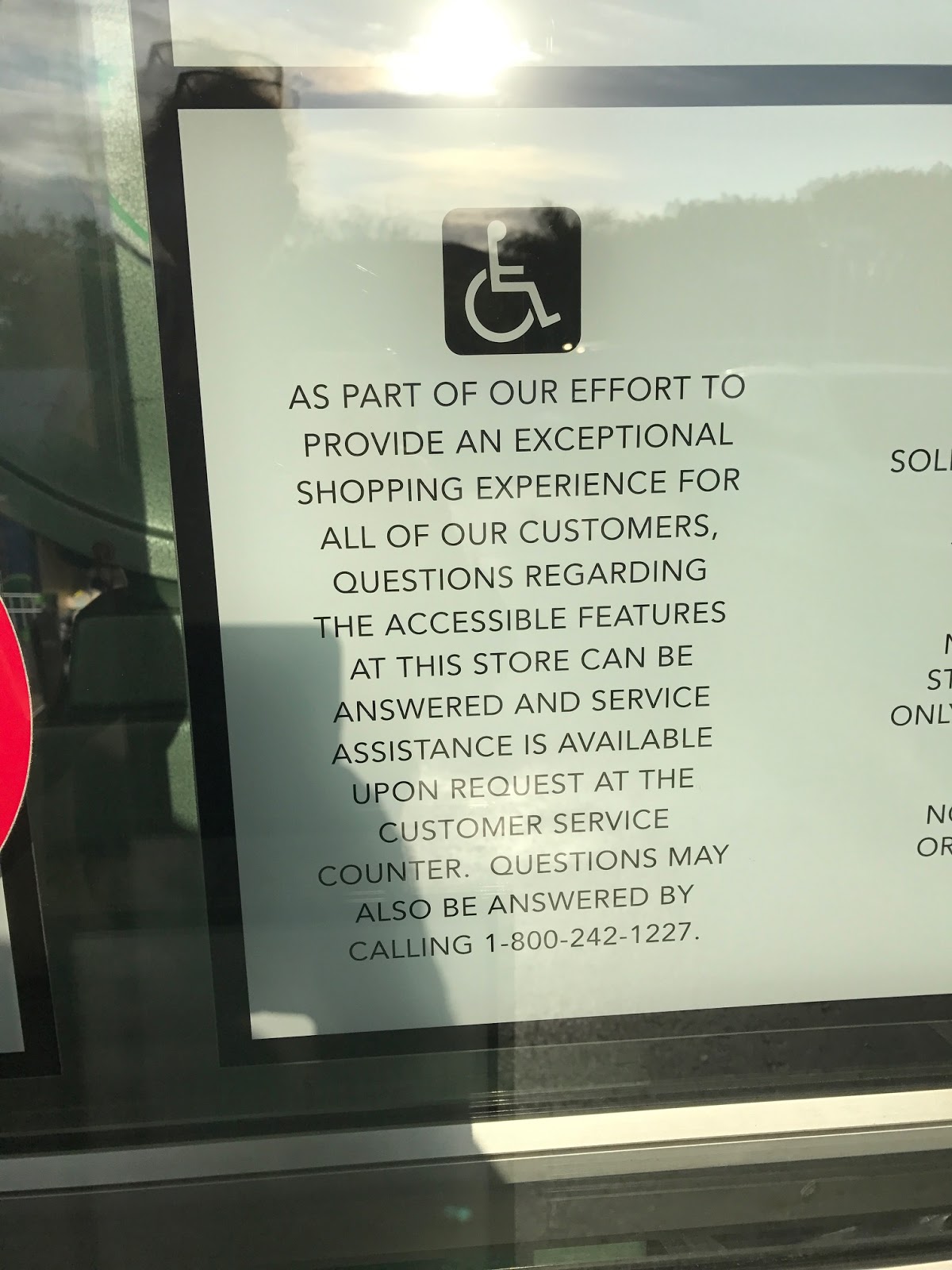
The use of multiple handicap parking spaces for commercial transactions doubly surprised me because Publix is quite aware of and sensitive to the challenges of the disabled.  In fact I see more persons with physical disabilities employed at Publix than I do most anywhere else in Florida.
Handicap Parking is Meant to Facilitate Access for Disabled Persons, not Commercial Enterprises

Kudos to Publix for recognizing the challenges of disabled persons!

Publix also displays their commitment to handicap accessibility with a large sign next to their front door.
Publix is Keenly Aware of the Importance of Handicap Access and Kudos to Publix for Their Efforts in Disabled Employment!

So I was actually taken aback with the 'intentional unintentional disability discrimination' by both Frito Lay and Publix with respect to Florida law, handicap parking and disabled persons access.

Moreover, these photos were taken after the store had opened.  But the law still applies to handicap parking after hours.  There is no excuse.

Truly I know there is no ill will towards persons with disabilities from either Publix or Frito Lay.  This is just another case of 'intentional unintentional disability discrimination'.

Yet it stings. And it is wrong.

Upon seeing the Frito Lay truck parked in the handicap spots and access isles I felt that same notion of being a second class citizen, one many other 'minorities' feel daily too.

But I only ask that we acknowledge what is real.  Disability discrimination does exist, daily.

And the only way to overcome disability discrimination is through awareness.

So, thank you Publix for all you do to help persons with disabilities.  And thank you Frito Lay too.

This may be an appropriate time to remind all parties that ensuring American with Disabilities Act compliance is an ongoing effort, one we can not afford to forget.

Intentional Unintentional Disability Discrimination is wrong.  We all need to stop ignoring it and work together to make it go away.


Wednesday, February 22, 2017

We are Overlooked Assets! #Marfan #EDS #LDS

Sometimes we as a nation can't see the trees for the forest.  When people make fun of those with disabilities, that jesting can foster cultural underestimations of talent values.
Connective Tissue Challenged Persons.  We are assets!

In the last week I've been declined for life insurance and jeered at while driving along with the other typical situations someone with a health challenge encounters daily.  Our van has a disability tag and I purposely drive the speed limit.  Other drivers often gun their engines to pass me by, blowing their horns loudly and usually flipping fingers my direction.  This week a man about my age rolled his windows down while flying by and twisted up his hands and face as if he were having a seizure then laughed as he sped on into the traffic ahead.

Today I take it all with a grain of salt assuming these people are probably having a really stressful day, pumped up on coffee and probably dealing with dangerously high blood pressure.  I am very happy with who I am, health challenges and all.  In fact I think my health challenges make me special.

Not everyone I encounter treats me this way.  Many are courteous, notice I am walking with a cane and treat me with kindness.  My doctors and nurses and their staff seem to really care and for this I am grateful. But our alpha nation, in its fast paced bootstrap mentality often treats those of us with pronounced health challenges as a discardable class.

Attitudes of disregard for the disabled can even be found in our governments.  Since my dissection in 2011 I've had my drivers license medically revoked and I've even been handcuffed, threatened and put on the ground by Flagler County Florida sheriff's department, hands on their guns and tasers as I walked to the grocery store one afternoon with my cane, a limping man that was an obvious threat to society.

Inevitably within the business community my resumes are politely returned, with a thank you but not interested response once my dissection issues surface.  Some say don't disclose the issue but I believe in transparency and it is hard to otherwise explain away the hospitalization time gap.

The 'forest' of mis-information and unfounded assumptions surrounding people with disabilities masks an amazing pool of talent though.

Over the past five years I've come to know others living with connective tissue challenges, aneurysms and dissections, scoliosis and pumphead, chairi and other conditions.

They are some of the most ingenious, brilliant, kind, enthusiastic and talented people I have ever known.

They are also surprisingly some of the healthiest persons I know, despite walking a fine line between life and death in many cases.

And they are certainly some of the most shrewdest and analytical persons on the planet.

Our communities, our nation and our world would be so much better off taping into this talent pool instead of pushing us to the side.

When living with a life threatening issue one realizes that time is truly borrowed and holds great value.  We can be better time managers than the most productive wall street executive for we know the value not only of each moment but of each breath.

And in spite of our challenges, many of us are more healthy than most.  Our diets are focused on  non-processed foods while we avoid inflammatory, artery clogging junk.  Our CT scans may reveal a dissection flap but they also reveal clean arterial pathways and healthy organs.

Yes, we may have physical or mental limitations but we've learned to adapt a better way and work around those issues.  Adaptation is a key component of long term evolution and survival.

Our awareness allows us to deal with and address our limitations - giving us an advantage over many of those who like the ostrich with its head in the sand, don't know what their arteries look like or haven't been to the doctor in a long time.

Besides, as someone recently reminded me, all of us are dying.  Those of us with diagnosed health challenges are just more keenly aware of this fact.  We are some say, better prepared than most when an incident occurs and in the meanwhile make the most of our allowed time.

Because of our focused efforts on our health I would suggest that we are a better class of individuals to issue life insurance policies for, rather than being rejected time after time for 'heart conditions' or other generic but unsubstantiated factors.  Yes we've disclosed these limitations on our applications.  They may sound 'un-insurable' at first take. Yet I still contend those of us with health challenges may be a better insurance wish than those in the population who appear healthy but may be walking time bombs themselves.

Over the years I've met some of the greatest artists, poets and well read intellectuals who each battle with serious or debilitating health issues.  There is an amazing pool of knowledge and creativity waiting to be tapped by a society willing to embrace differences.

And we would make the very best of employees.

All we need is a chance.

But the life insurance rejection letters, the returned job applications, the brush-offs, dismissals and cold shoulders, exhaust smoke and fingers still keep coming.

Fortunately, we are a resilient group.  We don't give up easily.

Many of us describe ourselves as 'survivors' or 'warriors', a fitting description for a group who have experienced trauma and difficulties most can not even imagine, and come through to the other side with strong fortitude and unspoken yet perfected resilience.

The world would be so much better off if this pool of talent was brought into the fold instead of being pushed to the side.

We truly are an overlooked worldwide asset.

And so we ask the world to take note of what we can offer.  We ask all the support organizations out there that provide us with wonderful resources on our afflictions to also advocate for our acceptance into mainstream society.

Those willing to take a risk on us will be rewarded far beyond their expectations.

Living a life challenged by connective tissue issues, cardiovascular and skeletal, vision and other maladies is the best training ground for human creativity and enlightenment.

All the world has to do is to ask for our help.

And if they don't then they'll be missing out.


Sunday, February 12, 2017

Some Good Days Some Bad Days but they are all Marfan Days

Some days are better than others.  This principle applies to all but may be especially relevant to those of us with chronic illnesses.
#IknowMarfan Become Involved! February is Marfan Awareness Month  www.marfan.org 

Others may see my smile, glossy nature photos on social media, and long walks as a sign that all is good.

But  I know the real truth.  Yes some days are better than others.  But every day is a Marfan day.

Most days I try and portray an upbeat attitude, usually answering a 'how are you?' question with 'everyday is a good day' answer.

And much of the time my positive answers and attitude convince even myself that connective tissue disorder life is not really that bad after all.  Especially on those days that are better than others.

Unfortunately, as I've said before, even the better days are still Marfan days.  This truth applies to all other connective tissue syndromes too; Loeys-Dietz (LDS), Ehlers Danlos (EDS) and so many others.

Even the best connective tissue disorder days are still connective tissue disorder days.

Amazingly a good Marfan day can instantly change and become a day some days are better than.  A wrong step, a bump against the door frame, a twist of the neck in the wrong direction, and even a hard sneeze can turn a 'better than other day' into the start of a painful, hurting week.
#IKnowMarfan Coumadin plays into Marfan days for many.  Here is my arm today - internal bleeding and hematoma 

Unless the torn tendon or ligament bleeds enough for a huge hematoma to form, or an arm or leg subluxes to where crutches are needed just to move, most others never even know how bad those with chronic connective tissue challenges may hurt.

Many of us look really fit, trim and healthy and we often hear the stinging compliment, "you look so good - so how can you be sick?!"

But even on those good days when we glow, smile and laugh the chronic monster of painful potential hovers just over our heads, ready to pounce at the first unexpected chance.

The concept of 'I may look somewhat ok' and 'this may be a better day than others but expect the unexpected' can really wear us down.

A Marfan day is a challenge, even if it may be one of the best of the better than other days.

Marfan can manifest in a number of ways including scoliosis, retinal detachment, muscle and joint disfunction and as in my case, mouth and teeth malformation to where I required braces, multiple hernias and worse - aortic dissection.

Today I live with a dissected descending aorta.  My ascending arch and aortic valve are mechanical and Dacron but my descending aorta is torn and blocked by about 70%.  Unfortunately I was unaware  of my connective tissue challenges until the night I dissected.  Had I known I could have potentially avoided my traumatic emergency surgery and subsequent surgery for graft infection.

Awareness is critically important.  And so we must share.  The Marfan Foundation provides educational and support resources concerning aortic dissection and other connective tissue challenges. To learn more about dissected aortas be sure to read the helpful information shared through the John Ritter Foundation website.

February is Marfan Awareness month.  So be sure to check out the #IknowMarfan hashtag across social media platforms and read more about Marfan Syndrome here.

Finally, many times a Marfan day will include more than just one connective tissue challenge.

For me the Post Traumatic Stress Disorder (PTSD) from two open heart aortic surgeries always looms just below the surface of daily activities.  Many days my upbeat approach to life masks the PTSD, other days something small or seemingly insignificant may trigger a rush of fear, dread and worry .  Some days are better than others but all Marfan days take their toll.

Most people in the world don't go through life aware their aorta is dilating every day, expanding and enlarging to the point where like a ballon, it may burst.  Living with the dread of imminent aorta replacement surgery is really stressful.  Even on the best of days the dread is hard to cope with.  But the aorta surgery worry is real and a part of most Marfan Days just as scoliosis, retinal detachment and other health challenges too manifest themselves most Marfan days.

Yes those of us challenged with Marfan Syndrome and other connective tissue disorders try mostly to 'get on with life' and 'keep on keeping on' or 'hanging in there'.  We try.

And many days that is just what we do and we are good at masking or hiding the hurt.

Then there are those less than better Marfan days where all the challenges just seem piled up way too high for us to deal with.  We want to let out a big sigh but our chest hurts way too much to let the sigh out.

No one understands so it seems.  Some days I feel like we are up the creek without a paddle, all alone, all by ourselves.

Social media support groups really do help but we long for an understanding touch, a personal hug from someone who does more than feel sorry from us.  We need someone who understands; really understands.

This is why becoming involved with The Marfan Foundation with local, but also national and worldwide efforts is so very important.

Each one of has so much to share and teach and receive from others.

We've been through those Marfan days.  We live them each and every day of our lives.

We've 'been there done that'.  Some of us have 'been there done that' for years now.

Whether it be retinal, muscular, cardiovascular or skeletal we all have some words of understanding to offer others.

Read through The Marfan Foundation's Get Involved website.  Become involved.  We have so much to share.  We need each other. Its all about awareness and sharing.

#IKnowMarfan